Thursday, February 13, 2014

Second test blog

Egbert was a son of Dirk II, Count of Holland. After being trained in Egmond Abbey, founded and controlled by his family, and at the court of Bruno I, Archbishop of Cologne, he became the chancellor of Otto II in 976. The following year he was appointed to the archdiocese of Trier, still probably in his twenties. He accompanied Otto II on visits to Italy in 980 and 983, and may have made other trips there. After Otto II's death in 983, he joined the party supporting the succession of Henry the QuarrelsomeDuke of Bavaria, rather than Otto III, but returned to supporting Otto in 985.[3]
Egbert was a significant patron of science and the arts, who established one or more workshops of goldsmiths and enamellers at Trier, which produced works for other Ottonian centres and the Imperial court. Beginning with his tenure, Trier came to rival Mainz and Cologne as the artistic centre of theOttonian world. These were the three most important episcopal sees in Germany, who at this period disputed the primacy of the emerging German (East Frankish) kingdom between them.[4]

First test post

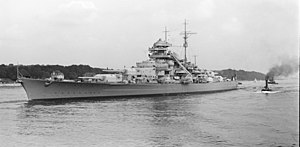
Bismarck was the first of two Bismarck-class battleships built for the German Kriegsmarine. Named after Chancellor Otto von Bismarck, the primary force behind the unification of Germany in 1871, the ship was laid down at the Blohm & Voss shipyard in Hamburg in July 1936 and launched two and a half years later in February 1939. Work was completed in August 1940, when she was commissioned into the German fleet. Bismarck and her sister ship Tirpitz were the largest battleships ever built by Germany, and two of the largest built by any European power.

In the course of the warship's eight-month career under its sole commanding officer, Capt. Ernst Lindemann, Bismarck conducted only one offensive operation, in May 1941, codenamed Rheinübung. The ship, along with the heavy cruiser Prinz Eugen, was to break into the Atlantic Ocean and raid Allied shipping from North America to Great Britain. The two ships were detected several times off Scandinavia, and British naval units were deployed to block their route. At the Battle of the Denmark Strait, Bismarck engaged and destroyed the battlecruiser HMS Hood, the pride of the Royal Navy, and forced the battleship HMS Prince of Wales to retreat; Bismarck herself was hit three times and suffered an oil leak from a ruptured tank.
The destruction of Hood spurred a relentless pursuit by the Royal Navy involving dozens of warships. Two days later, while heading for the relative safety of occupied France, Bismarck was attacked by obsolete biplane Fairey Swordfish torpedo bombers from the aircraft carrier HMS Ark Royal; one scored a hit that rendered the battleship's steering gear inoperable. In her final battle the following morning, Bismarck was neutralised by a sustained bombardment from a British fleet, was scuttled by her crew, and sank with heavy loss of life. Most experts agree that the battle damage would have caused her to sink eventually. In June 1989, several years after discovering the wreck of the Titanic, Robert Ballard located the wreck, which has since been surveyed by several other expeditions.